More Human, Not Less: What AGI Got Me Thinking About
· 8 min read · By Chris Stevenson
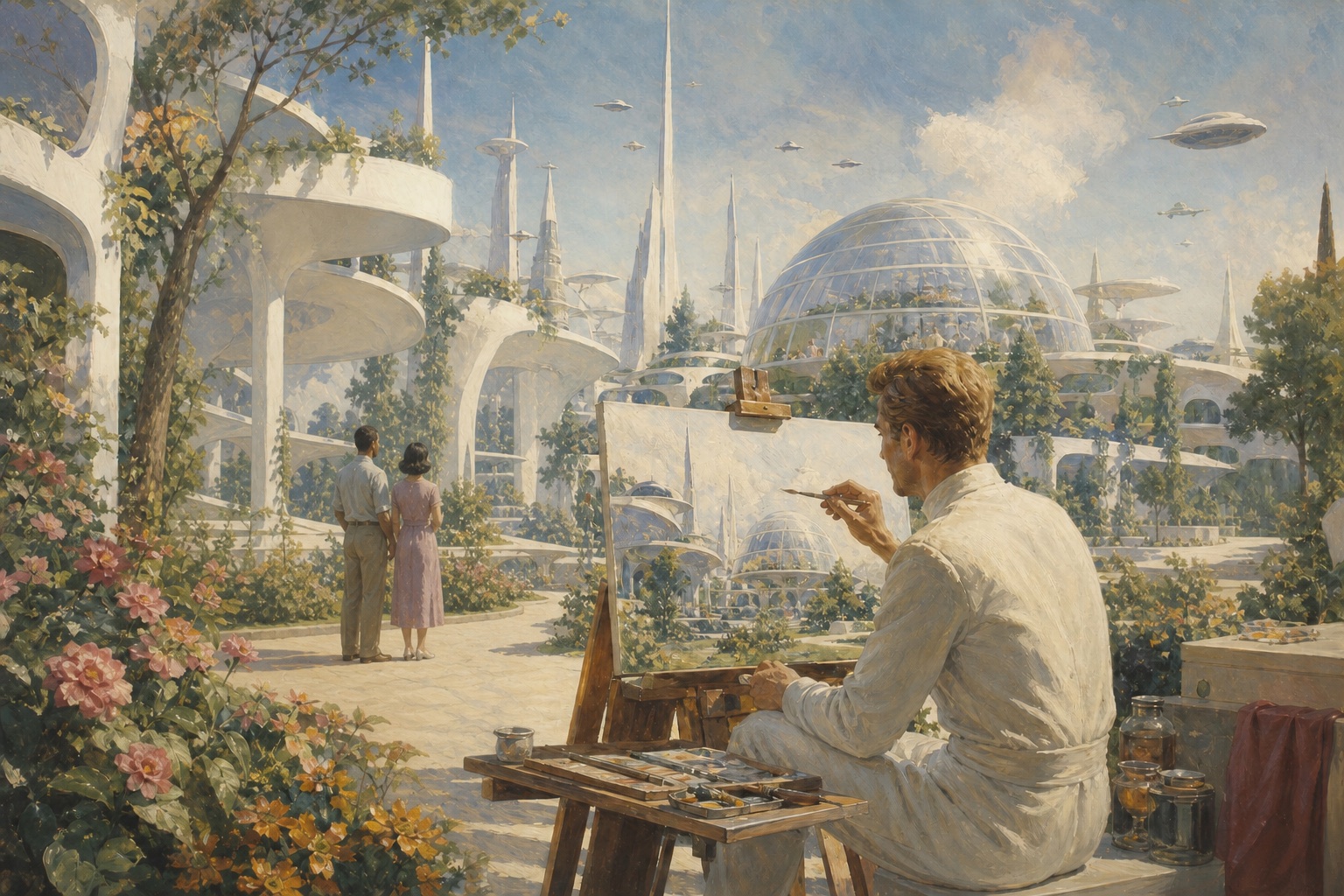
I recently started with a simple question: What is AGI really?
Depending on who you ask, AGI (Artificial General Intelligence) is already here, just around the corner, or something that may never exist at all. The more I thought about it, the more I realized that the debate over definitions may not be the most important part.
What matters is impact.
Whether we call it AGI, advanced AI, intelligent systems, or something else entirely, the reality is that technology is already changing how work gets done. AI can write, analyze, code, research, create images, and help solve problems. More importantly, it can amplify what a person can accomplish.
From my perspective, the question isn't whether machines can do more. They clearly can. The real question is what humans should focus on as that happens.
One of the conclusions I keep coming back to is that as technology becomes more capable, human value becomes more important.
Take something as simple as my mother's handmade embroidered tablecloths. A machine can produce something that looks nearly identical, faster and cheaper. Most people would choose the machine-made version and never think twice.
Yet someone else might spend thousands of dollars on the handmade piece, not because it functions better, but because it represents craftsmanship, effort, history, and a connection to another human being.
That idea extends far beyond embroidery.
In a world where software can be created by people who never learned to code, where images can be generated in seconds, and where content can be produced endlessly, the value of authenticity may increase.
We have seen this before.
Old hand-painted movie posters are still admired decades later. Not because they were efficient, but because people can see the artist in the work. The same may become true for many things in the future. Technology may make creation abundant. Human authenticity may become the scarce resource.
As I kept pulling on the thread, the questions got bigger than AI.
What happens when robots build products, harvest food, and even build other robots?
What happens when energy becomes cheap and abundant?
What happens when manufacturing becomes so automated that creating a product is almost as easy as ordering one?
At some point, money itself may become less important than access to energy, compute, materials, and manufacturing capacity. The economy could shift from paying for labor to allocating resources.
Whether we ever get something as advanced as a Star Trek replicator is beside the point. The trend is already visible. We are steadily improving our ability to transform energy and raw materials into useful products with less and less human labor.
But technology itself is not what concerns me most.
Human institutions do.
The greatest opportunities ahead include curing diseases, reducing hunger, improving education, and creating abundance on a scale never before seen.
The greatest risks involve concentration of power, loss of trust, overreliance on technology, and people surrendering too much decision-making to systems they do not understand.
Which brings me back to something I believe strongly.
The future belongs to people who increase their human value.
Throughout my career, I have always loved technology. I grew up through LPs, cassette tapes, VHS, CDs, DVDs, iPods, smartphones, cloud computing, and now AI. I've watched entire industries transform multiple times.
But if I'm honest, technology alone did not build my career.
Integrity did. Work ethic did. Being dependable did. Treating people well did.
The skills helped. The character traits made the difference.
When I talk to my daughter, who was born in 2008, I encourage her to learn these new tools. She should absolutely embrace the future. But I also tell her not to compete with machines at being a machine.
Instead, develop judgment. Develop integrity. Develop empathy. Develop communication skills. Become someone people trust.
Those qualities do not become obsolete.
I have learned that technical skills may get you qualified, but integrity, character, and relationships are often what create opportunity. Looking back on my own life, the jobs, projects, and opportunities that mattered most came through trust. People knew I would show up, work hard, tell the truth, and do my best to solve the problem in front of me.
Another lesson I've learned is that convenience is not always progress.
Technology can make life easier, but humans still need challenge. We need resistance.
We need to walk sometimes instead of ride. Take the stairs instead of the elevator. Build things. Learn difficult skills. Take risks. Fail. Try again.
Growth comes from resistance.
A muscle grows because it encounters resistance. Character grows because it encounters adversity. Confidence grows because we survive challenges we once thought were impossible.
I often say that I believe in failing up.
Mistakes are not the end of the process. They are often the beginning of the next level of growth.
Another part of being human that I think matters deeply is our need to create.
Creation is not just production. A machine can produce, but humans create from passion, memory, struggle, curiosity, love, and the desire to solve something.
We create because something moves us.
We create music, art, tools, buildings, stories, systems, and ideas. Sometimes we create by learning from what another human made before us. Sometimes we create by looking at nature: the shape of branches, the structure of a flower, the colors of a sunrise, the strength of natural patterns, and the beauty that already exists in the world.
Every creator stands on the shoulders of creators who came before them. We learn, adapt, improve, and reimagine. That process is one of the most human things we do.
Creation is how humans take experience and turn it into meaning.
That also connects to love, which may be the deepest human attribute of all.
Love is difficult to define and may never be fully explained. Yet we know it when we experience it.
It drives sacrifice. It drives loyalty. It drives family. It drives friendship. It drives purpose.
Much of the greatest art, music, literature, architecture, and innovation in human history came from a desire to express something that words alone could not capture.
Technology may help us build, design, write, and imagine.
But the human ability to love, to care, and to create from feeling is something different.
That is part of what I mean by increasing human value.
There is also a bit of irony in this very essay.
AI helped me write it.
But AI did not write it.
The ideas came from a conversation. They came from my experiences, my observations, my values, my concerns, and my hopes for the future. The technology helped organize those thoughts, refine the wording, and improve the flow.
That distinction matters.
I have never considered myself a great writer. Spelling, grammar, and formal writing have never been my strongest skills. But I know a good idea when I see one. I know what resonates with me. I know what reflects my own experiences and beliefs.
This essay is a perfect example of how I think these tools are best used.
Not as a replacement for human thought. Not as a replacement for human creativity. But as an amplifier of human capability.
The finished result belongs neither to the machine nor to the human alone. It came from the collaboration between the two.
To me, that feels less like replacement and more like evolution.
Finally, I think we need to put the term "AI" into perspective.
Today, AI is everywhere. It has become an all-encompassing term that dominates nearly every conversation about technology.
But I suspect that one day it will be viewed much like the internet.
We still say "the internet," but we rarely think about it. We talk about websites, online shopping, streaming, social media, cloud services, and applications. The internet is simply the infrastructure underneath.
The same thing may happen with AI.
One day we may stop talking about AI so much because it will simply be embedded into everything we do.
We'll talk about medicine, education, engineering, entertainment, manufacturing, communication, and countless other fields.
The intelligence behind those systems will simply be part of the environment.
Kind of like that old comedian making fun of people who talk about "the Internets."
At some point, the technology becomes ordinary.
The human being using it remains the interesting part.
That's why, despite all the excitement around AI, AGI, robotics, automation, and whatever comes next, I keep coming back to the same conclusion:
Technology changes. Human nature doesn't.
And the people who combine technological capability with integrity, curiosity, adaptability, creativity, love, and genuine human connection will be the ones best positioned to thrive in whatever future arrives.
The goal is not to resist technology.
The goal is to use technology to become more human, not less.